



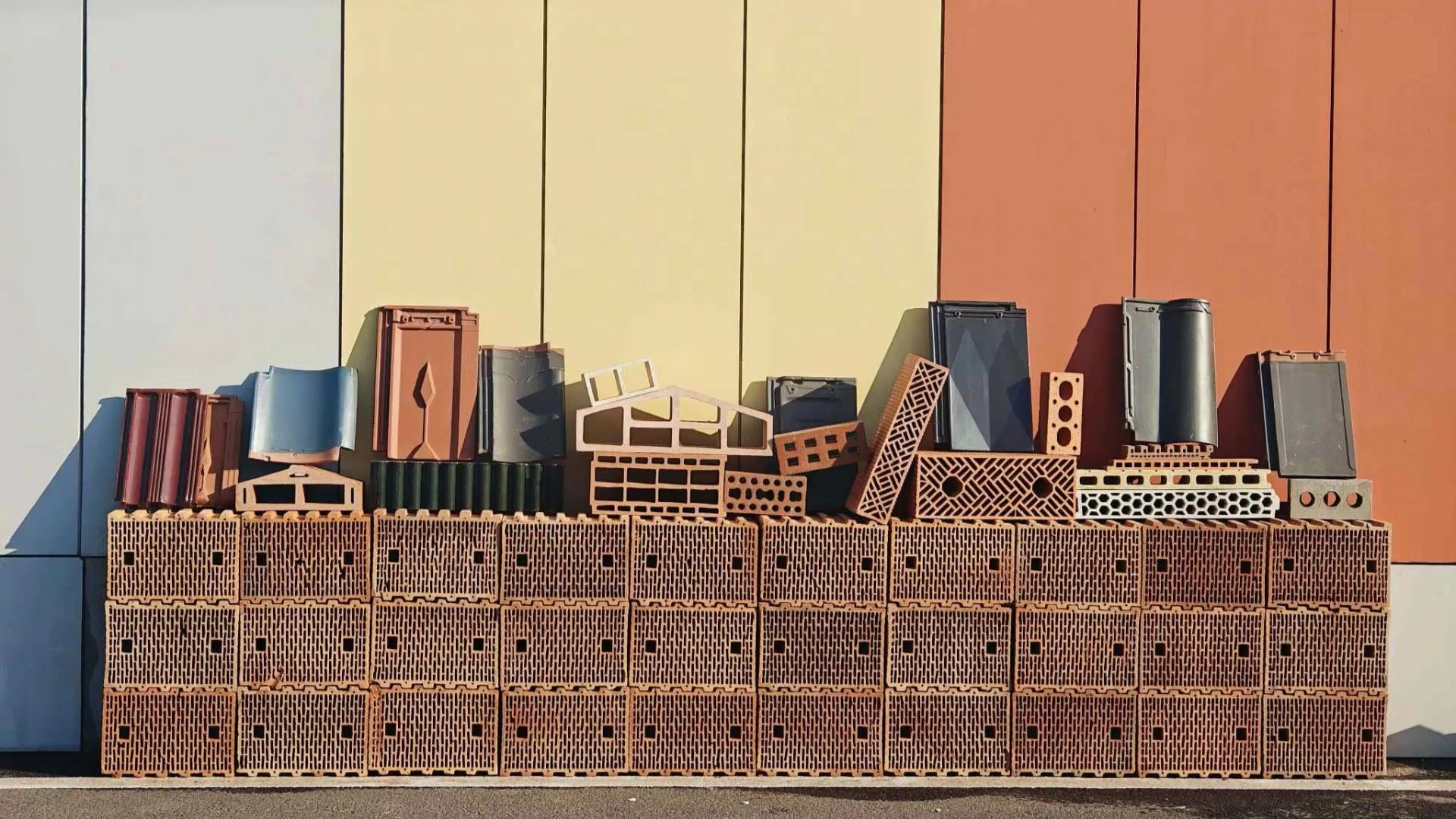
Fully Automatic Twice Stacking Ceramic Face Brick Tunnel Kiln
Our Fully Automatic Twice‑Stacking Ceramic Face Brick Tunnel Kiln uses external firing technology, supporting gas, oil and husk fuels.
Built for green fired brick secondary firing, it removes drying trays, adopts servo green‑body conveyance and same‑side loading/unloading to save space. Our self‑developed DSC control platform ensures stable full‑auto operation.
Green bodies go through preheating, high‑temperature sintering and cooling on kiln cars. Available widths: 2.5m‑9m, with suspended refractory brick or aluminum‑silicate fiber kiln roof.
Ideal for high‑end public building ceramic face bricks. Replaces manual secondary firing lines, lowers labor costs and improves product quality.
The Fully Automatic Twice Stacking Ceramic Face Brick Tunnel Kiln is an advanced continuous firing system specially designed for the production of ceramic face bricks, clay bricks, and other high-quality wall materials. It adopts external firing technology using natural gas, oil, or other fuels as the heat source.
Since the late 1990s, China’s brick industry has faced problems such as high investment costs, complicated production processes, difficult maintenance, and insufficient advantages of secondary yard burning processes. At the same time, the traditional one-step code-burning technology has limited the improvement of product quality and restricted the development of high-end sintered wall materials.
With the increasing application of clean bricks and green bricks in high-end public buildings such as hospitals, schools, museums, libraries, and cultural tourism centers, traditional production methods can no longer meet the requirements of modern factories. Many clean brick production lines still rely heavily on manual operation, resulting in low automation levels and difficulties caused by labor shortages.
To solve these problems, our company follows global development trends and independently develops a new generation of fully automatic secondary code-firing technology, which greatly improves production efficiency, automation level, and product quality.
Product Features
1. Simplified Production Process
The traditional drying trolley process is eliminated, greatly simplifying the production procedure and reducing operational complexity.
2. Optimized Drying Vehicle Design
The drying vehicle structure has been redesigned to ensure smoother connection between the product conveying system and the upper and lower-level production systems, improving stability and efficiency.
3. High-Efficiency Conveying and Automatic Control Technology
By introducing advanced ceramic tile conveying technology, the system uses a large number of servo motors to precisely control:
- Green brick handling
- Vehicle movement
- Positioning and alignment
- Automatic connection between production units
This ensures accurate operation and stable production.
4. Compact Layout Design
The upper and lower shelves are arranged on the same side of the dryer, which simplifies the production line layout, saves factory space, and improves equipment utilization.
5. Intelligent Integrated Control System
The newly developed DSC distributed integrated control platform combines:
- Variable frequency servo control
- Photoelectric sensors
- Proximity sensors
- Travel sensors
- Position detection systems
- Timing control systems
All systems are integrated through PLC and configuration software, realizing intelligent and automated production management.
Working Principle of Tunnel Kiln
A tunnel kiln works based on a continuous production mode. Green bricks are loaded onto kiln cars and continuously transported through different temperature zones inside the kiln to complete the firing process.
1. Loading and Transportation
Green bricks are placed on kiln cars, which enter the kiln through tracks or roller conveying systems.
2. Preheating Zone
The green bricks first enter the preheating zone, where the temperature gradually increases. Moisture is removed from the bricks, and waste heat from the kiln can be recycled to improve thermal efficiency.
3. Firing Zone
The bricks enter the high-temperature firing zone, where they reach the required sintering temperature and complete the ceramic firing process.
4. Cooling Zone
After firing, the bricks gradually enter the cooling zone, where the temperature decreases to a suitable level for unloading.
5. Continuous Production
Kiln cars continuously move through the kiln. New green bricks enter while finished bricks are unloaded, achieving continuous and efficient production.
Structure of Tunnel Kiln
1. Kiln Body:
The main structure is an elongated passage equipped with tracks or rollers inside. It supports and transports kiln cars carrying green bricks through the kiln.
2. Preheating Zone:
The first section after entering the kiln. The temperature gradually increases to remove moisture and prepare bricks for firing.
3. Firing Zone:
The core area of the tunnel kiln with the highest temperature. Bricks are sintered here to achieve the required strength, density, and appearance quality.
4. Cooling Zone:
The area where fired bricks are gradually cooled to a temperature suitable for unloading and packaging.
5. Combustion System :
Provides the heat required for firing. It mainly includes:
- Burners
- Fuel supply system
- Exhaust system
The system ensures stable combustion and efficient energy utilization.
6. Ventilation System
Controls airflow inside the kiln to ensure:
- Complete combustion
- Uniform temperature distribution
- Stable firing quality
7. Driving System
Used to move kiln cars through the kiln. It usually includes:
- Motors
- Chain drive systems
- Roller drive devices
Advantages
- High automation level and reduced labor dependence
- Continuous production with high efficiency
- Lower energy consumption through waste heat utilization
- Improved firing uniformity and product quality
- Compact factory layout and space saving
- Intelligent PLC control system for easy operation
- Suitable for modern green brick and clean brick production plants
- Applicable for large-scale international brick manufacturing projects
Technical Parameters:
| Tunnel inside width | Height of above kiln car surface |
Daily capacity | 10,000 brick firing fuel consumption |
| 2.4 m | 1.6~2 m | ≥80,000 pieces | < 49×10⁶ KJ |
| 3.5 m | 1.6~2 m | ≥150,000 pieces | < 49×10⁶ KJ |
| 4.6 m | 1.6~2 m | ≥200,000 pieces | < 49×10⁶ KJ |
| 6.9 m | 1.6~2 m | ≥300,000 pieces | < 49×10⁶ KJ |