



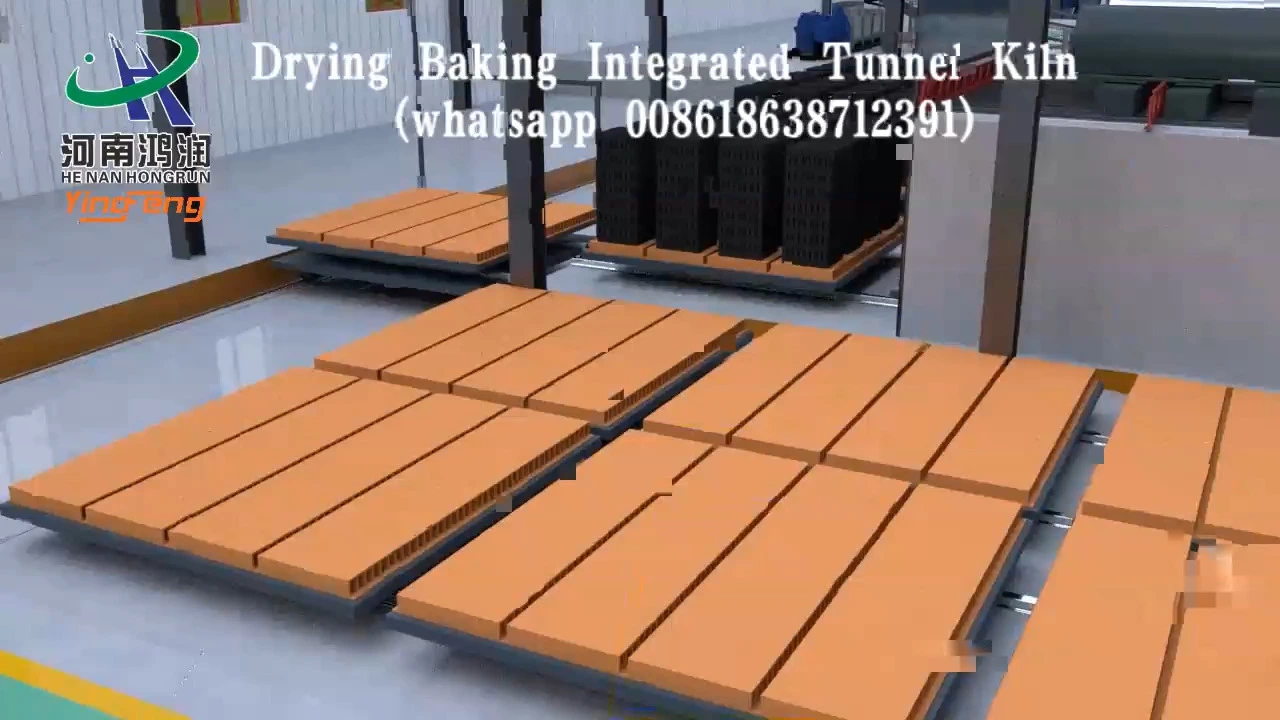
Drying and firing integrated Linear tunnel kiln
Compared with the traditional tunnel kiln, the drying and firing integrated tunnel kiln has a simpler operation, lower investment, and saves energy consumption by more than 20%.
"Firing and Drying Integrated Tunnel Kiln" typically refers to a tunnel kiln system that integrates the drying (firing) and sintering (burning) processes into a single continuous operation. This enables the integrated production of green bodies from entering the kiln as wet bodies, through drying and dehumidification, preheating, sintering, to cooling. Its main advantages are reflected in the following aspects:
Main Advantages
- Simplified Process and Convenient Operation
By combining drying and sintering into a single production line, intermediate steps such as body handling, stacking reversal, and car pushing are reduced, lowering manual intervention and labor intensity.
- Lower Investment Cost
Compared to independent systems with separate drying chambers and sintering kilns, the integrated structure saves on civil engineering, equipment, and floor space. It is particularly suitable for small and medium-scale brick factories or the production of sintered bricks using raw materials such as coal gangue and shale.
- Higher Energy Utilization Efficiency
The residual heat from the sintering section is used to heat the drying section, reducing the need for external energy. Some designs further optimize airflow through parallel multi-chamber kilns to enhance thermal utilization.
- Suitable for Continuous and Large-Scale Production
Using continuous in-and-out kiln cars in conjunction with automated control systems, it can achieve stable 24-hour operation, making it suitable for production lines with an annual output of tens of millions of standard bricks.
- More Stable Product Quality
Under reasonable design and control, the temperature field inside the kiln is uniform, and the firing cycle is controllable, which helps improve brick strength and appearance consistency.
The drying and firing integrated linear assembled tunnel kiln production line system mainly includes raw material workshop, crushing workshop, aging workshop, green brick making workshop, automatic stacking system, transfer system, green brick storage workshop, drying kiln body, firing kiln, air duct system, automatic firing system, and flue gas purification treatment system.
Technical Parameters:
| Tunnel inside width | Height of above kiln car surface |
Daily capacity | 10,000 brick firing fuel consumption |
| 2.4 m | 1.6~2 m | ≥80,000 pieces | < 49×10⁶ KJ |
| 3.5 m | 1.6~2 m | ≥150,000 pieces | < 49×10⁶ KJ |
| 4.6 m | 1.6~2 m | ≥200,000 pieces | < 49×10⁶ KJ |
| 6.9 m | 1.6~2 m | ≥300,000 pieces | < 49×10⁶ KJ |
Q1: How to make red bricks?
A1: The production process of sintered bricks is generally composed of four parts: raw material preparation, blank body forming, wet blank drying, and finished product firing.After raw materials are excavated, some can be processed by adding water, stirring and grinding equipment,while others will not work.Raw materials,such as mountain soil, coal gangue and shale,are to be broken and finely chopped, then followed by water mixing and grinding.The choice and preparation of raw materials directly affect the quality of the finished product.As the saying goes, raw materials are fundamental to making sintered bricks,showing the importance of the raw materials preparation and raw materials.
After the selected brick raw materials are processed, they enter the molding workshop for molding.Blank forming method basically uses plastic extrusion molding in China.There are three methods for plastic extrusion. That is plastic extrusion molding,semi-hard plastic extrusion molding and hard plastic extrusion molding.
These three extrusion methods are based on the difference in the moisture content of the molding.When the moisture content more than 16%,wet billet molding is plastic extrusion molding. When the moisture content equals 14-16%, it’s semi-hard plastic extrusion molding. When the moisture content equals 12-14% ,it’s hard plastic extrusion molding.Blank forming includes: feeding material , mixing,adding water and grinding equipment processing before raw materials entering the molding shop not brick extruding machine.After passing through the molding brick machine, the qualified mud and wet billet are formed.Forming process should fulfill the requirement of the shape and structure.Forming is the foundation of the brick making process.The quality of the formed body is directly related to the appearance quality of the finished tile.
After the wet billets formed from the molding plant, they need to be dried by dehydration.In the production process of sintered bricks, there are two ways of drying wet blank: natural drying and artificial drying.
The natural drying is to place the wet billet on the billet stalk in the natural drying place,manually invert the code and use the atmosphere to wet the cold billet into a dry billet.Artificial drying is to use equipped artificial drying chamber to dry wet billet.The artificial drying room is divided into three types: large-section tunnel drying room, small-section tunnel drying room and chamber drying room.Whichever type is adopted, it is manually or mechanically placing wet billet on a drying truck,then put it into drying chamber.The heat medium in the drying chamber generally comes from the waste heat of the sintering kiln or the hot blast stove.Whichever drying method is adopted, it must be ensured that the blank will not be deformed or chapped during the drying process.If the wet billet can’t guarantee the appearance quality of the product during drying, it will cause high reject rate, falling output,increasing cost of the finished brick, which are definitely harmful to company economic efficiency.This shows the importance of drying wet billet in brick making process.
If the residual moisture rate after drying is less than 6%,the wet billet could be fired in the baking kiln.Hoffman kiln and tunnel kiln are normally used for roasting.When using Hoffman kiln, the brick code is manually placed in the kiln and the fire is roasted in the kiln.When using tunnel kiln,the brick code is manually or mechanically placed in the kiln cart.The kiln car enters kiln head and exits from the kiln tail. The brick blanks on the kiln car are roasted into bricks.The roasting flame in the kiln doesn’t move just the kiln cart.Whether using Hoffman kiln or tunnel kiln,this two conditions must be followed:1.never use underfire to produce unburnt brick.2.never use big fire to produce coke brick.It is often said that roasting is the key of the brick making process,which explains the importance of roasting in the brick making process.
Sintered brick process is composed of four parts.To sum up,it is said that the raw material is fundamental,molding is the basis,drying is ensure and roasting is the key. These four parts are interdependent.
Q2: How to make bricks from clay ?
A2: A brick is building material used to make walls, pavements and other elements in masonry construction. Traditionally, the term brick referred to a unit composed of clay, but it is now used to denote any rectangular units laid in mortar. A brick can be composed of clay-bearing soil, sand, and lime, or concrete materials. Bricks are produced in numerous classes, types, materials, and sizes which vary with region and time period, and are produced in bulk quantities. Two basic categories of bricks are fired and non-fired bricks.
Block is a similar term referring to a rectangular building unit composed of similar materials, but is usually larger than a brick. Lightweight bricks (also called lightweight blocks) are made from expanded clay aggregate.
Fired bricks are one of the longest-lasting and strongest building materials, sometimes referred to as artificial stone, and have been used since circa 5000 BC. Air-dried bricks, also known as mudbricks, have a history older than fired bricks, and have an additional ingredient of a mechanical binder such as straw.
Bricks are laid in courses and numerous patterns known as bonds, collectively known as brickwork, and may be laid in various kinds of mortar to hold the bricks together to make a durable structure.